

How it works
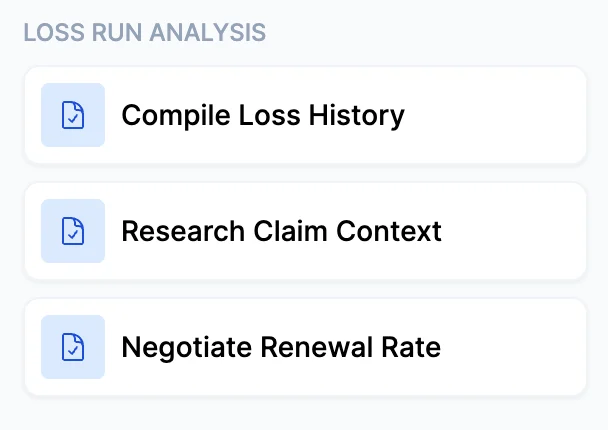
Loss Run Analysis
1
Upload loss run documents
Upload the loss run documents. You can upload multiple files — one per line of business, multi-year runs, or any combination.
No loss runs to upload? Run the preset anyway. Cara will note that no runs were provided, document the clean claims history, and produce a Risk Mitigation Statement for a zero-loss account. This is a strong advocacy position for new business submissions.
2
Upload supporting documents (optional)
Optionally upload the application, quote, or current policy documents. These help Cara identify which lines of business are being submitted and tailor the research and Risk Mitigation Statement accordingly.
3
Add notes
Use the notes field to provide context about the submission — whether it’s new business or a renewal, any specific concerns about the loss history, or the lines of business being quoted. This context shapes how the Risk Mitigation Statement is framed.
4
Review the output
The output is organized into four sections:Executive Summary — A one-sentence risk assessment with color-coded indicators for: Lines of Business Submitted, Overall Risk Profile (🟢 / 🟡 / 🔴), Loss Trend (Improving / Stable / Worsening), and External Research (Clean / Mixed / Adverse).Loss Run Summary — Total claim count, total incurred, period covered, and the most notable trend. The full claim-by-claim table is available in a collapsible dropdown; the main view shows the aggregate summary by year and line of business.External Risk Research — One paragraph per research area relevant to the submission lines. Areas not applicable to the submission are noted as such rather than left blank. All citations and search details are available in a dropdown.Risk Mitigation Statement — A professional memo addressed to the underwriter, under 400 words. It acknowledges the loss history directly, contextualizes significant claims, documents existing risk controls, highlights favorable external findings, and closes with a specific ask for new business or renewal rate consideration.
Loss controls Cara identifies as current practice are stated plainly in the Risk Mitigation Statement. Loss controls that are industry best practice but not confirmed as currently in place are marked with an asterisk (*) and positioned as forward-looking commitments. The asterisk footnote appears at the end of the statement.
5
Next steps
From here, you can:
- Ask Cara to adjust the tone or emphasis of the Risk Mitigation Statement
- Request an Excel version of the claims summary for your records
- Use the loss control recommendations as the basis for a risk improvement conversation with the insured
- Run Underwriting Analysis alongside this if you want a full application audit before going to market
How the Risk Mitigation Statement is written
The statement is advocacy, not a report. It is written to make the case that this is a desirable risk — not to minimize losses, but to contextualize them honestly and present the insured’s risk management practices in the best accurate light. A few things Cara is specifically instructed to do — and not do — in the statement:- Claims are acknowledged, not buried. The statement opens by referencing the loss history directly. Underwriters notice when submissions try to avoid mentioning losses.
- Claim count is never framed as a positive signal. Higher frequency — even with zero-payout notifications — is a negative underwriting indicator. The statement doesn’t position it otherwise.
- Adverse external findings are disclosed to the agent but never appear in the statement. If web research surfaces something unfavorable, it’s included in the External Risk Research section for your awareness — not sent to the underwriter.
Tips for best results
- Research is scoped to the submission lines. If the submission is Workers Comp only, Cara focuses the research and Risk Mitigation Statement on WC-relevant factors — OSHA record, payroll benchmarks, workplace safety — and skips research that applies to other lines. This keeps the output focused and efficient.
- The full claim table is always in a dropdown. The main view stays scannable with aggregate summaries; the detailed claim-by-claim breakdown is available when you need it.
- Discuss asterisked loss controls with the insured before or shortly after submission. These are controls Cara has recommended based on the loss history but that aren’t confirmed as currently in place. Committing to them in the statement means the agency should follow through.